
Facial Trauma & Facial Fracture Surgery
Facial injuries can affect appearance, bite, jaw movement, vision, breathing and facial symmetry. Accurate evaluation of the facial skeleton helps determine whether a fracture can be observed or requires reduction and surgical fixation.


Facial Trauma Is More Than Visible Swelling
Facial trauma may result from road traffic accidents, falls, sports injuries, workplace accidents or direct impact to the face.
The injury may involve one facial bone or several areas at the same time. Treatment focuses on restoring anatomy while protecting essential functions such as chewing, speech, eye movement and normal dental occlusion.
Medical anatomy illustration for patient education. Individual fracture patterns are determined through clinical examination and imaging.
Which Facial Bones Can Be Fractured?
Mandibular Fracture
Fractures of the lower jaw may affect the symphysis, body, angle, ramus or condylar region and can alter the patient's bite.
Zygomatic / Cheekbone Fracture
Cheekbone fractures may affect facial projection, mouth opening and structures around the eye.
Orbital Fracture
Fractures around the eye socket may be associated with double vision, restricted eye movement or altered sensation.
Maxillary / Midface Fracture
Midface trauma can affect the upper jaw, facial height, dental occlusion and facial stability.
Nasal / NOE Fractures
Nasal and naso-orbito-ethmoid injuries can affect nasal shape, airway function and the region between the eyes.
Panfacial Fractures
High-energy trauma may involve multiple areas of the facial skeleton and require complex reconstruction.
Examples of Facial Fractures on Medical Imaging
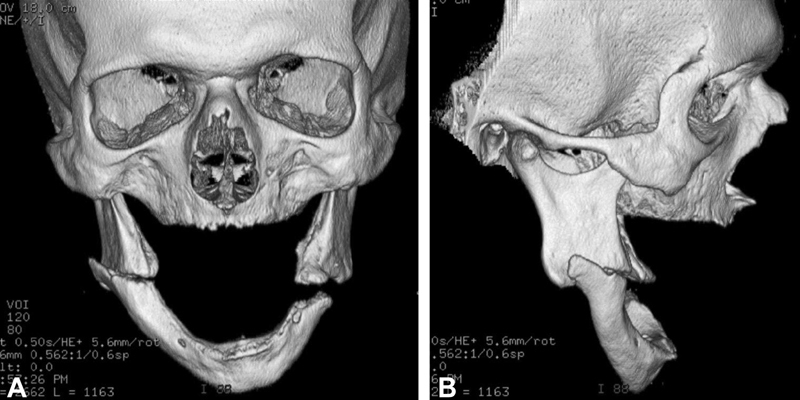
These images are included for patient education only. The appearance and treatment of each fracture varies according to the patient's actual injury.
Lower Jaw Fracture
Mandibular fractures can disturb dental occlusion, jaw movement and sensation around the lower lip or chin.

Cheekbone Fracture
Zygomatic injuries can cause flattening of the cheek, facial asymmetry and restriction in mouth opening.

Zygomatic & Maxillary Injury
CT can demonstrate fracture location and displacement in the cheekbone and surrounding maxillary structures.
A Mandibular Fracture Can Occur at Different Sites
The lower jaw has several anatomical regions. Treatment depends on the location of the fracture, amount of displacement and whether the bite has changed.
- Symphysis and parasymphysis
- Body of the mandible
- Angle of the mandible
- Ramus
- Condylar region


Le Fort & Maxillary Fractures
Significant facial trauma can cause fracture patterns that pass through the maxilla and surrounding midface.
These injuries may affect the upper dental arch, nasal region, orbit and facial buttresses. Treatment planning considers facial stability, bite, airway and overall facial projection.
Three-dimensional CT reconstructions can help the surgical team understand complex fracture patterns and plan reconstruction.
Request Specialist EvaluationSymptoms That Should Not Be Ignored After Facial Injury
A relatively small external wound can sometimes accompany a deeper facial bone fracture.
Changed Bite
Your upper and lower teeth may no longer meet normally.
Double Vision
Blurred or double vision after facial trauma requires prompt medical assessment.
Facial Numbness
Altered sensation around the cheek, lower lip or chin can occur when nearby nerves are affected.
Restricted Mouth Opening
Jaw movement may become painful or restricted after mandibular or cheekbone trauma.
Facial Asymmetry
Flattening or displacement of the cheek or jaw may indicate bony movement.
Bleeding or Open Wounds
Facial lacerations can occur together with underlying bone fractures.
Bony Tenderness
Localized pain, deformity or a step in the facial contour can suggest fracture.
Increasing Swelling
Significant swelling following injury should be assessed, especially when accompanied by functional symptoms.
How Facial Fractures Are Evaluated
Clinical examination and appropriate imaging help determine which facial bones are fractured, whether fragments are displaced and which nearby structures may be involved.
What Happens When a Facial Fracture Needs Surgery?
Not every facial fracture requires an operation. Surgery may be considered when fractures are displaced, unstable or interfere with normal facial function.
Assessment & Stabilisation
Urgent medical priorities and associated injuries are addressed first.
Fracture Mapping
Clinical findings and imaging are reviewed to understand the fracture configuration.
Reduction
The displaced bone segments are repositioned toward their normal anatomical position.
Internal Fixation
Plates and screws may be used to keep selected fractures stable during healing.
Follow-Up
Bite, jaw movement, wounds, facial contour and fracture healing are monitored.

What Facial Fracture Surgery Aims to Restore
Facial Alignment
Reposition displaced facial bones toward their normal anatomical relationship.
Dental Occlusion
Restore the way the upper and lower teeth meet when jaw fractures affect the bite.
Function
Protect jaw movement, chewing, eye movement and other important functions.
Facial Symmetry
Restore facial projection and contour as closely as possible after displacement.
Recovery After Facial Fracture Surgery
The recovery plan depends on the fracture type, associated injuries and operation performed.
Swelling Management
Follow postoperative instructions regarding elevation, medication and wound care.
Modified Diet
A soft or modified diet may be required while jaw and facial bones heal.
Oral Hygiene
Careful oral hygiene is particularly important when incisions are placed inside the mouth.
Regular Follow-Up
Follow-up helps monitor bite, jaw movement, wounds and fracture stability.

Dr. Reena Yadav
Facial trauma treatment requires detailed knowledge of facial bone anatomy, jaw function, dental occlusion, soft tissue and facial symmetry.
Dr. Reena Yadav evaluates facial injuries ranging from isolated jaw fractures to complex maxillofacial trauma, with treatment planned according to the fracture pattern and the patient's functional needs.
Facial Swelling After an Accident Should Not Be Ignored
Pain and swelling can hide an underlying facial fracture. If you have facial asymmetry, difficulty opening your mouth, a changed bite, numbness or vision problems after an injury, seek an appropriate medical evaluation.