

Head & Neck
Head & Neck Lumps
Evaluation of persistent lymph nodes, cystic swellings, soft-tissue masses and suspicious neck lumps.
A lump in the neck, swelling near the jaw or ear, persistent salivary gland enlargement or an abnormality seen inside the jaw should be properly evaluated rather than ignored. Accurate diagnosis helps distinguish infection and benign conditions from problems that may require biopsy or surgical treatment.

A lump in the neck or around the jaw can arise from several different structures including lymph nodes, salivary glands, skin, soft tissues, blood vessels, nerves or deeper head-and-neck structures.
Some lumps develop because of infection and resolve after appropriate treatment. Others may represent salivary gland problems, cysts, benign tumours, enlarged lymph nodes or, less commonly, malignant disease.
These symptoms do not necessarily indicate cancer. However, persistent or unexplained changes should be assessed clinically.
A lump that does not settle or continues to increase in size should be professionally evaluated.
Swelling around the parotid or submandibular region may originate from a salivary gland.
Pain or swelling that increases while eating may be associated with salivary duct obstruction or stones.
Unexplained expansion of the upper or lower jaw requires clinical and radiographic examination.
Loosening or movement of teeth without a clear dental cause can occasionally relate to jaw pathology.
Persistent altered sensation or numbness around the jaw, lip or face needs investigation.
Restricted jaw opening associated with swelling should not be ignored.
Rapidly enlarging or progressively growing swelling requires prompt assessment.
Diagnosis depends on understanding exactly where the swelling originates — the neck, a salivary gland or inside the jaw bone.
Evaluation of persistent lymph nodes, cystic swellings, soft-tissue masses and suspicious neck lumps.
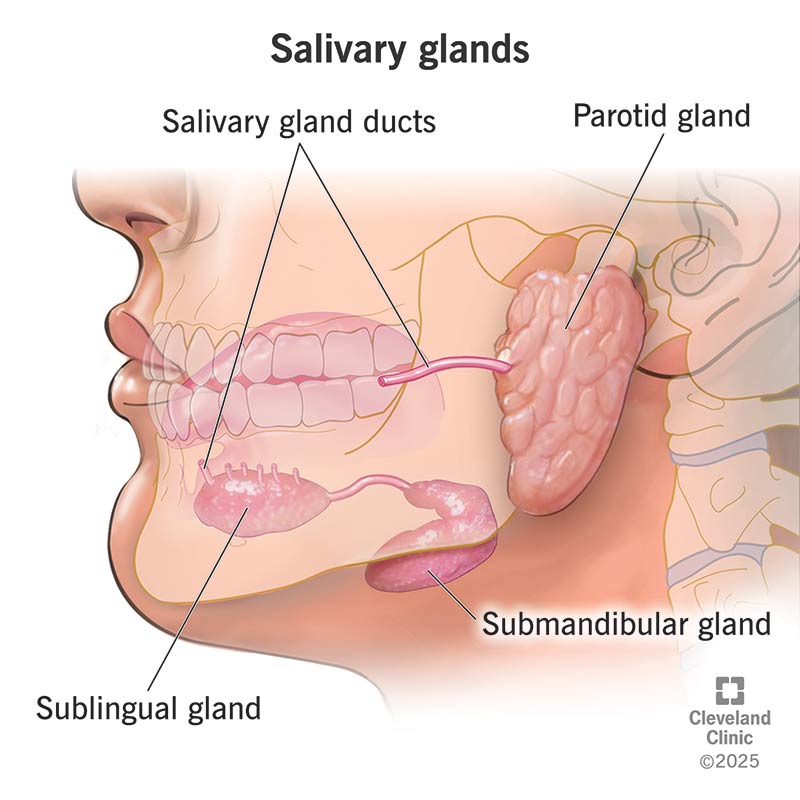
Evaluation of parotid, submandibular and sublingual gland swelling including stones, infection, cysts and tumours.

Assessment of cystic or tumour-like abnormalities affecting the mandible, maxilla, teeth and surrounding jaw bone.
The major salivary glands include the parotid glands near the ears, submandibular glands beneath the lower jaw and sublingual glands beneath the tongue.
Stones may block salivary flow and produce pain or swelling, particularly around mealtimes.
Inflammation or infection can cause painful gland swelling and tenderness.
Cystic swellings can occur in major or minor salivary glands and may require imaging or surgery.
Some salivary gland tumours are non-cancerous but may continue growing and require removal.
Certain salivary tumours can be cancerous and need careful diagnostic and surgical planning.
Some jaw abnormalities are discovered incidentally on dental X-rays, while others cause swelling, pain, tooth movement or facial asymmetry.
Duration, pain, growth, dental symptoms and previous infections are reviewed.
The mouth, jaw, face, salivary glands and neck are examined.
Imaging may include OPG, ultrasound, CBCT, CT or MRI.
FNAC or biopsy may be recommended when definitive diagnosis is needed.
No. Treatment depends entirely on the diagnosis.
Some inflammatory or infectious swellings may respond to medical treatment, while salivary stones, persistent cysts or tumours may require a procedure or surgery.
A lump that is enlarging deserves prompt assessment.
A firm persistent mass should be clinically examined.
Facial weakness with a salivary-region mass requires specialist evaluation.
Jaw expansion or altered sensation warrants investigation.
Dr. Reena Yadav provides specialist evaluation and surgical care for conditions affecting the mouth, jaws, face and neck, including salivary gland disorders, jaw cysts and tumours, oral pathology and head-and-neck disease.
Do not try to diagnose persistent swelling through photographs alone. An in-person clinical examination can help determine whether you need reassurance, imaging, biopsy or treatment.