
Jaw Fracture Management
A fractured lower jaw can affect much more than the bone itself. Patients may develop pain, swelling, difficulty chewing, numbness or a sudden change in the way their upper and lower teeth meet. Specialist assessment helps restore jaw alignment, bite and function.

A changed bite after facial injury can indicate displacement of the jaw and should be assessed clinically.
What Is a Mandibular Fracture?
The mandible is the lower jaw bone. It holds the lower teeth, contributes to facial shape and connects to the skull through the temporomandibular joints.
A significant blow to the jaw may create a fracture at one or several locations. Because muscles continuously act on the mandible, fractured segments can move and disturb normal dental occlusion.
One part of the jaw may be fractured after localized trauma.
High-impact injuries may fracture the mandible at more than one site.
Bone segments have moved away from their normal alignment.
The jaw may be fractured into multiple smaller bony fragments.

Common Locations of Mandibular Fractures
The treatment approach can differ depending on where the fracture is located and whether it is displaced.
Symphysis
Central chin region at the front of the mandible.
Parasymphysis
Region adjacent to the central chin area.
Body
Tooth-bearing horizontal portion of the lower jaw.
Angle
Posterior region where the horizontal jaw turns upward.
Ramus
Vertical posterior segment of the mandible.
Condylar Region
Upper end of the mandible forming part of the jaw joint.
Symptoms After Trauma That Need Evaluation
Symptoms vary with fracture location and displacement. Not every patient has every sign.
Changed Bite
The upper and lower teeth may no longer fit together normally.
Jaw Pain & Swelling
Pain and swelling may increase when speaking, chewing or moving the jaw.
Restricted Opening
Opening or closing the mouth may become difficult or painful.
Lip or Chin Numbness
Altered sensation can occur if the inferior alveolar nerve is affected.
Jaw Deformity
The chin or jawline may look displaced or asymmetric after injury.
Bleeding Inside the Mouth
Gum or mucosal injury can accompany fractures near tooth-bearing areas.
Abnormal Jaw Movement
Movement may feel unstable or the jaw may deviate while opening.
Loose or Injured Teeth
Dental injuries can occur together with a jaw fracture.
Seeing the Fracture Clearly
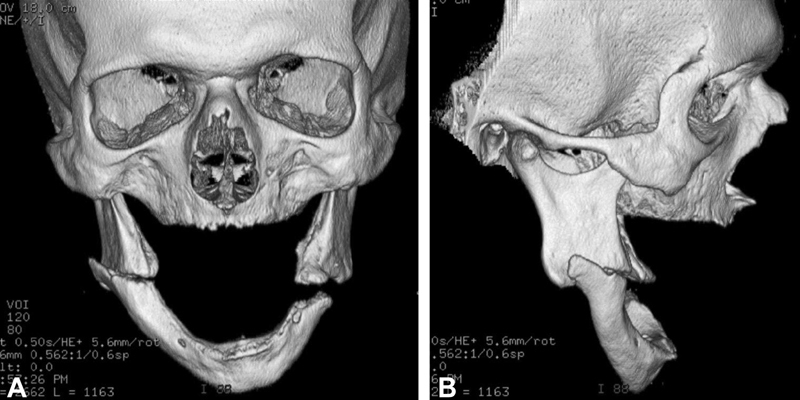
Understanding Displacement in Three Dimensions
CT and 3D reconstruction can help visualize the fracture pattern, displacement and relationship of different jaw segments when detailed cross-sectional imaging is needed.
Panoramic / Jaw Imaging
OPG and other jaw imaging can be useful for evaluating many mandibular injuries and associated teeth.

Does Every Jaw Fracture Need Surgery?
No. Management depends on the exact fracture pattern, degree of displacement, stability, dental occlusion, patient age, associated injuries and other clinical factors.
Closed Management vs Surgical Fixation
The most appropriate option is selected after clinical assessment and imaging. There is no single treatment method for every mandibular fracture.
Closed Reduction / Jaw Stabilisation
Selected fractures can sometimes be managed without directly exposing the fracture site surgically.
- Alignment of upper and lower dental arches
- Elastics or maxillomandibular fixation when indicated
- Regular monitoring of the bite
- Diet modification during healing
- Jaw rehabilitation when appropriate

Open Reduction & Internal Fixation
For many displaced fractures, surgery allows direct repositioning of the fractured segments followed by internal fixation.
- Fracture segments repositioned anatomically
- Dental occlusion carefully restored
- Plates and screws may stabilise the fracture
- Fixation strategy depends on fracture location
- Postoperative review monitors healing and function

What Jaw Fracture Surgery Aims to Restore
The purpose of surgery is not simply to place plates. The main goal is to restore the anatomical and functional relationship of the jaw.
Upper and lower teeth should return as closely as possible to their pre-injury relationship.
Displaced jaw segments are repositioned toward normal anatomy.
Adequate stability helps maintain the corrected jaw position.
Treatment considers chewing, mouth opening and movement.
Your Jaw Fracture Recovery Roadmap
Recovery varies according to the fracture pattern and treatment performed. Follow your surgeon's individual instructions rather than relying on a fixed timeline.
Early Phase
Swelling, pain control, wound care and monitoring of the bite are priorities.
Protected Healing
Diet and jaw activity are modified while the fracture gains stability.
Functional Recovery
Jaw opening and movement may be gradually progressed according to clinical advice.
Follow-Up
Occlusion, jaw mobility, sensation and fracture healing are reviewed over time.
Diet, Oral Hygiene & Jaw Care Matter
The jaw is involved every time you chew, speak or swallow. Post-treatment instructions therefore play an important role during healing.
A soft or liquid diet may be advised according to fracture stability and treatment.
Careful cleaning helps keep teeth, gums and intraoral surgical sites clean.
Do not return to hard chewing or contact activity before your surgeon advises it is appropriate.
Follow-up allows the surgeon to assess bite, wounds and jaw movement.
Dr. Reena Yadav
Jaw fracture treatment requires knowledge of facial skeletal anatomy, dental occlusion and functional jaw movement.
Dr. Reena Yadav evaluates mandibular and other facial fractures in Mumbai, with treatment planned according to fracture location, displacement, bite and the patient's overall injury.
Jaw Pain After an Accident? Check the Bite, Not Just the Swelling.
A mandibular fracture can sometimes be missed when attention is focused only on swelling. If your teeth suddenly do not meet normally, your jaw feels unstable, your lower lip is numb or mouth opening is difficult after trauma, arrange a specialist assessment.