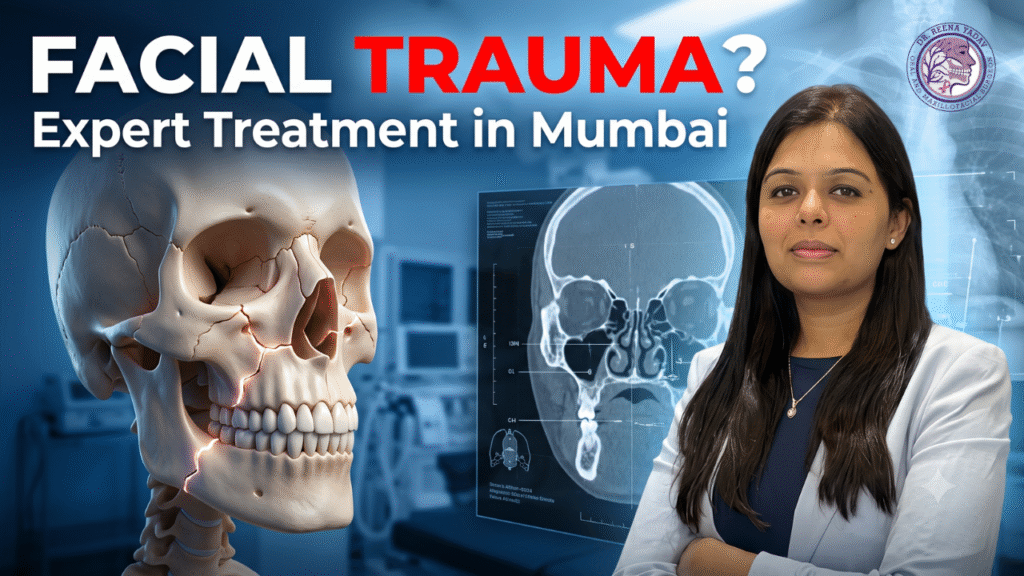
Facial injuries are among the most physically and emotionally impactful injuries a person can experience. They affect not just your appearance but your ability to eat, breathe, speak, and see. Whether you have been in a road accident, suffered a sports injury, experienced a fall, or been the victim of violence — skilled facial trauma care can make the difference between disfigurement and full recovery.
Dr. Reena Yadav is an experienced oral and maxillofacial surgeon in Mumbai specialising in the management of facial trauma — from soft tissue lacerations to complex midface fractures and jaw reconstruction.
What Is Facial Trauma?
Facial trauma encompasses any injury to the bones or soft tissues of the face — including the forehead, eyes, nose, cheeks, upper jaw (maxilla), lower jaw (mandible), teeth, lips, and skin. The maxillofacial region is highly complex, housing critical structures involved in vision, breathing, chewing, speech, and facial expression.
In India, the leading causes of facial trauma include:
- Road traffic accidents (RTAs) — the most common cause, particularly motorbike injuries
- Falls from heights — common in construction workers and the elderly
- Interpersonal violence and assault
- Sports injuries — cricket, kabaddi, football
- Industrial and workplace accidents
Many facial trauma cases arrive as emergencies — but even patients who have been treated elsewhere and are left with deformity, pain, or functional problems can benefit from reconstructive care.
Types of Facial Fractures
Mandible (Lower Jaw) Fractures
The mandible is the most frequently fractured bone of the face. Common fracture sites include the symphysis (front of the chin), condyle (near the TMJ), angle (behind the wisdom teeth), and body (the main portion of the jaw).
Symptoms: inability to close teeth properly, jaw deviation to one side, pain on chewing, swelling, and numbness in the lower lip (injury to the inferior alveolar nerve).
Zygomatic (Cheekbone) Fractures
The zygoma (cheekbone) provides the prominent contour of the mid-face. A fracture here — typically from a direct blow — can cause flattening of the cheek, reduced mouth opening, double vision (if the orbit floor is involved), and infraorbital nerve numbness (tingling/numbness below the eye).
Orbital Fractures (Eye Socket)
Blunt trauma to the eye area can fracture the thin bones forming the orbital floor or walls. The resulting ‘blow-out fracture’ can cause the eye to sink inward (enophthalmos), restrict eye movement, and cause diplopia (double vision). These require prompt surgical repair to restore normal vision and eye position.
Nasal Fractures
The nose is the most commonly fractured bone in the face, given its prominence. A nasal fracture may cause swelling, bruising around the eyes, deformity, and breathing difficulty. Most can be reduced (repositioned) under local anaesthesia within 1–2 weeks of injury, before the bones set in the wrong position.
Midface (Le Fort) Fractures
High-energy trauma — such as a road accident at speed — can fracture the entire midface in complex patterns. Le Fort fractures are classified into three types (I, II, III) depending on the fracture line through the midface. These are serious injuries that affect facial projection, the bite, and in severe cases, the skull base. They require hospital admission and often staged surgical reconstruction.
Panfacial Fractures
In the most severe trauma cases, multiple facial regions are fractured simultaneously (mandible, maxilla, zygoma, orbit, nose). These ‘panfacial fractures’ require meticulous surgical planning and are typically repaired using a combination of internal fixation and external support.
When to Seek Emergency Care for a Facial Injury
Always seek immediate care if you experience:
- Inability to open or close your mouth after an injury
- Teeth that no longer meet properly (malocclusion)
- Visible bone or tooth through a wound
- Double vision or inability to move the eye normally
- Severe swelling around the eye, nose, or cheek after trauma
- Numbness in the face, lips, or chin
- Bleeding from the mouth, nose, or ear that won’t stop
- Loss of consciousness, even briefly, following a blow to the face
Call Dr. Reena Yadav’s clinic immediately: +91 77388 06741. Facial fractures treated within the first 2 weeks have significantly better outcomes than those treated late.
How Is Facial Trauma Diagnosed?
A thorough evaluation is essential before any treatment is planned:
- Clinical examination: assessment of facial symmetry, bite alignment, sensation, eye movement, and wound evaluation
- OPG (panoramic X-ray): initial assessment of jaw fractures
- CT scan (with 3D reconstruction): gold standard for evaluating the extent of all facial fractures — provides a three-dimensional view of every bone
- Ophthalmology review: if the orbit or eye is involved
- Neurosurgery review: if intracranial injury is suspected (skull base fractures)
Facial Trauma Treatment — What to Expect
Soft Tissue Injuries (Lacerations, Contusions)
Facial lacerations require meticulous, layered closure to minimise scarring. The face heals exceptionally well due to its rich blood supply, but proper technique matters — especially around the lips, eyelids, and nose. Dr. Reena Yadav performs careful wound exploration to ensure no foreign bodies or bone fragments are left in place.
Fracture Fixation — ORIF
Most facial fractures that require surgery are treated with Open Reduction and Internal Fixation (ORIF). This involves:
- Exposing the fractured bone through carefully placed incisions (often hidden inside the mouth or in natural skin folds)
- Precisely repositioning the fragments into their correct anatomical position
- Securing them with titanium plates and screws that are permanent, lightweight, and MRI-compatible
Titanium plates used in facial surgery are thin, low-profile, and biocompatible — they do not need to be removed in most cases and are not detectable under the skin.
Mandible Fractures — Specific Approaches
- Symphysis/body fractures: typically accessed through incisions inside the mouth
- Condyle fractures: many can be managed conservatively with jaw physiotherapy and intermaxillary fixation (IMF); displaced condyle fractures may require surgery
- IMF (jaw wiring): in some cases, the upper and lower teeth are temporarily wired or banded together to allow healing — typically for 4–6 weeks
Orbital Floor Repair
Orbital blow-out fractures are repaired through a small incision below the eye or inside the eyelid (transconjunctival). A thin titanium mesh or absorbable implant is used to reconstruct the floor and support the eye.
Zygomatic Fracture Reduction
Cheekbone fractures are often approached through small incisions in the scalp, mouth, or eyelid crease — designed to keep scars hidden. The depressed cheekbone is elevated and fixated with micro plates.
Recovery After Facial Trauma Surgery
Recovery timelines depend on the complexity of injuries:
- Minor fractures (nasal, isolated zygomatic): 2–4 weeks recovery; swelling resolves in 6–8 weeks
- Jaw fractures with IMF: 4–6 weeks of liquid/soft diet; physiotherapy begins after wire removal
- Complex midface or panfacial fractures: 6–12 weeks to full recovery; some swelling may persist for 3–6 months
Post-operative care includes:
- Antibiotics and anti-inflammatory medications
- Strict soft food or liquid diet during healing
- Oral hygiene instructions and wound care
- Regular follow-up at 1 week, 2 weeks, 1 month, and 3 months
- Physiotherapy for jaw mobility after mandible fractures
Most patients are pleasantly surprised by how well they heal. The face is one of the fastest-healing regions of the body, and with skilled surgery, the goal is always to restore pre-injury appearance and function as closely as possible.
Late Presentation & Reconstruction
Not all patients receive timely treatment. Some arrive weeks or months after injury — with healed-but-malpositioned bones, facial asymmetry, restricted jaw opening, or unresolved nerve injury. Dr. Reena Yadav also offers secondary (delayed) reconstruction:
- Osteotomies to re-fracture and realign malunited bones
- Bone grafting to fill defects
- Scar revision for unsatisfactory facial scars
- Nerve decompression for persistent numbness
Why Choose Dr. Reena Yadav for Facial Trauma Care in Mumbai?
- Over 13 years of experience managing complex maxillofacial trauma
- Skilled in all facial fracture types — mandible, zygoma, orbit, midface, panfacial
- Access to hospital-based surgical facilities at Jai Ambe and RMS Multi-Speciality Hospital
- Collaborative care with neurosurgeons, ophthalmologists, and plastic surgeons when needed
- Available for urgent consultations — reach out immediately after trauma
Contact Dr. Reena Yadav for Facial Trauma Treatment in Mumbai
Facial trauma is time-sensitive. The sooner treatment is initiated, the better the outcome. Do not wait.