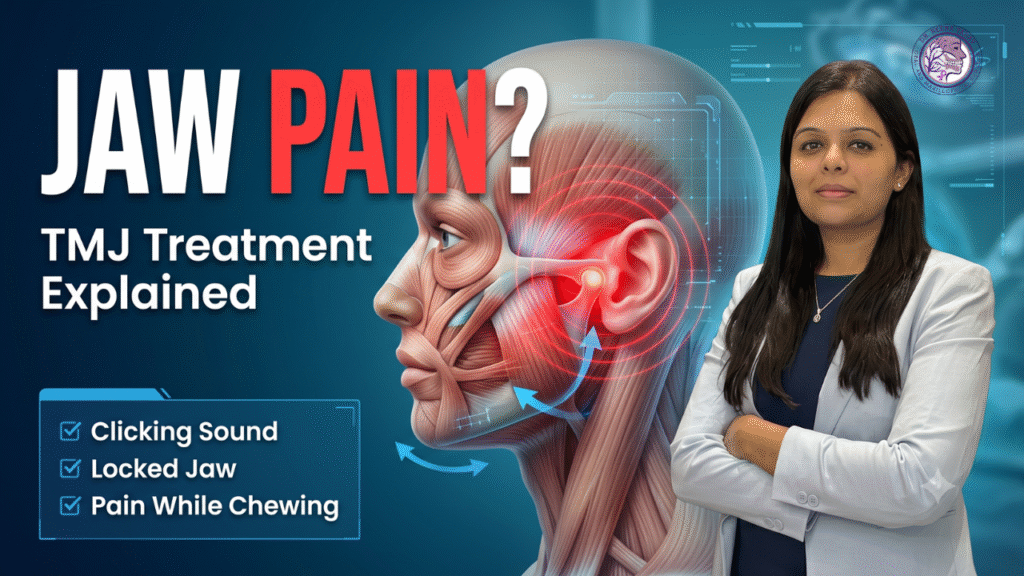
If you wake up with jaw pain, experience a clicking or popping sound when you chew, or find it difficult to open your mouth fully — you may be dealing with a temporomandibular joint (TMJ) disorder. TMJ problems are more common than most people realise, yet they are frequently misdiagnosed as dental pain or tension headaches.
Dr. Reena Yadav is one of very few maxillofacial surgeons in Mumbai who has undergone a dedicated TMJ Mini Residency at the University of Maryland, USA — bringing world-class expertise in diagnosing and treating the full spectrum of temporomandibular joint conditions.
What Is the TMJ?
The temporomandibular joint (TMJ) is the hinge joint located just in front of your ear, on each side of your face. It connects your lower jaw (mandible) to your skull (temporal bone) and allows your jaw to move up and down, side to side — enabling you to talk, chew, yawn, and swallow.
This joint is one of the most complex in the human body. It is supported by muscles, ligaments, and a small disc (articular disc) that cushions movement. When any component of this system malfunctions, it results in what doctors call a temporomandibular disorder (TMD).
Common Symptoms of TMJ Disorders
TMJ symptoms can vary widely from person to person, which is why the condition is often misattributed to dental problems, ear infections, or migraines. Common symptoms include:
- Jaw pain or soreness, especially in the morning or after eating
- Clicking, popping, or grating sounds when opening or closing the mouth
- Difficulty or discomfort when chewing hard foods
- Locking of the jaw — either open or closed
- Limited range of motion when opening the mouth
- Pain in or around the ear (without infection)
- Frequent headaches, particularly at the temples
- Neck and shoulder pain or stiffness
- Facial muscle fatigue or tenderness
- Tooth sensitivity, wear, or pain without dental cause
Many patients visit 3–4 doctors — dentist, ENT, neurologist — before reaching a maxillofacial specialist. If you have persistent jaw pain and no clear diagnosis, ask for a referral to an OMS specialist.
What Causes TMJ Disorders?
Disc Displacement
The articular disc inside the joint can slip out of position (anteriorly or posteriorly), causing the characteristic clicking sound and reduced jaw opening. In severe cases, the disc becomes permanently displaced and the jaw locks.
Bruxism (Teeth Grinding/Clenching)
Chronic teeth grinding or clenching — often during sleep — puts enormous stress on the TMJ, muscles, and tooth surfaces. Stress and anxiety are major contributors. Many patients are unaware they grind their teeth until a dentist notices the wear patterns.
Arthritis of the TMJ
Like any joint in the body, the TMJ can develop osteoarthritis (degenerative) or rheumatoid arthritis (inflammatory). This leads to cartilage loss, bone-on-bone contact, and chronic pain that worsens over time without treatment.
Trauma & Injury
A blow to the face, motor accident, or whiplash can injure the joint directly, causing internal derangement, fractures to the condyle (the rounded end of the lower jaw), or damage to surrounding muscles.
Malocclusion & Dental Issues
A significantly misaligned bite (malocclusion), missing teeth, or poorly fitting dentures can alter the way the jaw closes and stress the joint unevenly over time.
Stress & Psychological Factors
Emotional stress is a well-documented trigger for TMJ disorders. It causes patients to tense their jaw muscles, clench their teeth, and hold the jaw in unnatural positions — all of which accelerate joint deterioration.
How Is a TMJ Disorder Diagnosed?
Diagnosis begins with a thorough clinical evaluation by Dr. Reena Yadav:
- Assessment of jaw opening range (normal is 40–50mm)
- Palpation of the TMJ and surrounding muscles
- Evaluation of bite alignment and dental occlusion
- Listening for joint sounds during movement
This is followed by imaging:
- OPG (panoramic X-ray): initial screening of the joint and jaw
- MRI of the TMJ: gold standard for evaluating disc position and soft tissue
- CBCT (3D scan): for assessing bone changes, condylar erosion, and arthritic changes
TMJ Treatment Options in Mumbai
Dr. Reena Yadav follows a stepwise, conservative-first approach — starting with the least invasive treatment and escalating only when necessary.
Stage 1: Conservative & Non-Surgical Management
- Occlusal splint therapy: a custom night guard to reduce grinding and offload the joint
- Physiotherapy: jaw exercises, ultrasound therapy, and TENS (transcutaneous electrical nerve stimulation)
- Medications: NSAIDs, muscle relaxants, anti-anxiety agents
- Dietary modification: soft food diet during flare-ups
- Stress management: counselling, mindfulness, sleep hygiene
The majority of TMJ patients (up to 80%) improve significantly with conservative management alone within 3–6 months.
Stage 2: Minimally Invasive Procedures
When conservative measures fail to provide relief, minimally invasive in-office procedures may be recommended:
- Arthrocentesis: a minimally invasive lavage procedure where the joint is flushed with sterile fluid to remove inflammatory by-products and restore disc mobility. Performed under local anaesthesia.
- Intra-articular injections: corticosteroid or hyaluronic acid (viscosupplementation) injections into the joint to reduce inflammation and improve lubrication
- Botulinum toxin (Botox) injections: for muscle hyperactivity and bruxism-related TMD, reducing muscle tension and pain
Stage 3: Surgical Management
A small percentage of TMJ patients with structural joint damage that doesn’t respond to conservative or minimally invasive treatment may require surgery:
- Arthroscopy: a key-hole procedure using a tiny camera to visualise the joint interior, remove adhesions, reposition the disc, and lavage the joint
- Open joint surgery (arthroplasty): for cases with severely displaced discs, bone abnormalities, or arthritic damage — involves direct access to the joint
- Total joint replacement: reserved for end-stage TMJ disease where the joint is beyond repair — involves replacing the condyle and/or fossa with prosthetic implants
Surgery is always the last resort. Dr. Reena Yadav’s commitment is to relieve your pain with the minimal intervention that achieves lasting results.
Living with TMJ — What to Avoid
While undergoing treatment, certain habits can worsen symptoms:
- Chewing on one side only
- Eating hard foods (raw carrots, crusty bread, hard candy)
- Resting your chin in your hand
- Clenching your teeth when stressed
- Aggressive yawning or wide mouth opening
- Chewing gum
Simple habit changes, combined with the right treatment, make a significant difference in recovery speed and outcome.
Why Dr. Reena Yadav Is Mumbai’s Go-To TMJ Specialist
- Completed a dedicated TMJ Mini Residency at the University of Maryland, USA — unique in Mumbai
- Proficient in the full spectrum from splint therapy to total joint replacement
- Evidence-based, patient-centred care with no unnecessary procedures
- Deep understanding of the psychological and muscular components of TMD
- Convenient locations on Mira Road — accessible from across Greater Mumbai
Book Your TMJ Consultation in Mumbai
Jaw pain is not something you need to live with. The right diagnosis and the right treatment plan can restore comfort and function — and Dr. Reena Yadav is here to guide you every step of the way.